

Marching Band Drumming vs. Highland Pipe Band Drumming: Same Sticks, Totally Different Planet
Drummers are a special breed of humans — part athlete, part musician, and part caffeine-fueled metronome. They hit things with purpose and precision while making it look ridiculously cool. But if you think all drumming is the same, you’ve clearly never seen a Highland pipe band drummer and a marching band drummer standing side by side.
Sure, they both wear uniforms, carry drums, and occasionally twirl their sticks like wizards — but that’s where the similarities end. The difference between the two worlds is like comparing a Scottish sword dance to a halftime show at the Super Bowl: both epic, both loud, but very, very different.
So grab your sticks, tighten your sling, and let’s dive into the wonderful chaos that separates (and secretly unites) these two drumming tribes.
1. The Music: Brass vs. Bagpipes
Let’s start with the obvious. Marching band drummers are surrounded by brass, woodwinds, and a conductor who looks like they just chugged three espressos. The music is big, bold, and dynamic — think movie soundtracks, pop tunes, and “Sweet Caroline” at football games.
Pipe band drummers? They’re in a very different sonic universe. Their melodic partners are bagpipes, and bagpipes… well, they play in one key. Constantly. Forever. Usually around A(ish) — depending on the humidity, temperature, and how mischievous the reeds feel that day.
That means pipe band drummers don’t have flashy tempo changes or dramatic crescendos. Instead, they build rhythm and texture within that one endless drone. They don’t just back the pipers — they dance with them rhythmically. It’s less about boom-crash and more about click-tap-sizzle-finesse.
So while a marching band drummer might be pounding out the finale to Bohemian Rhapsody, a pipe band drummer is crafting a delicate, rolling tattoo to make the pipes sing. Both are awesome. One might get you a high school trophy; the other might get you a pint after the parade.
2. The Instruments: The Hardware Wars
At first glance, both styles use snare drums, tenors, and bass drums. But once you look closer, you realize you’ve wandered into two completely different dimensions.
Marching band drums are often sleek, modern, and (let’s be honest) built like small tanks. They’re made for projection — the snares are tight enough to bounce a quarter, and the tenors look like a futuristic space cannon array. You’ve got quads, quints, even sextets — all mounted on harnesses that could double as medieval armor.
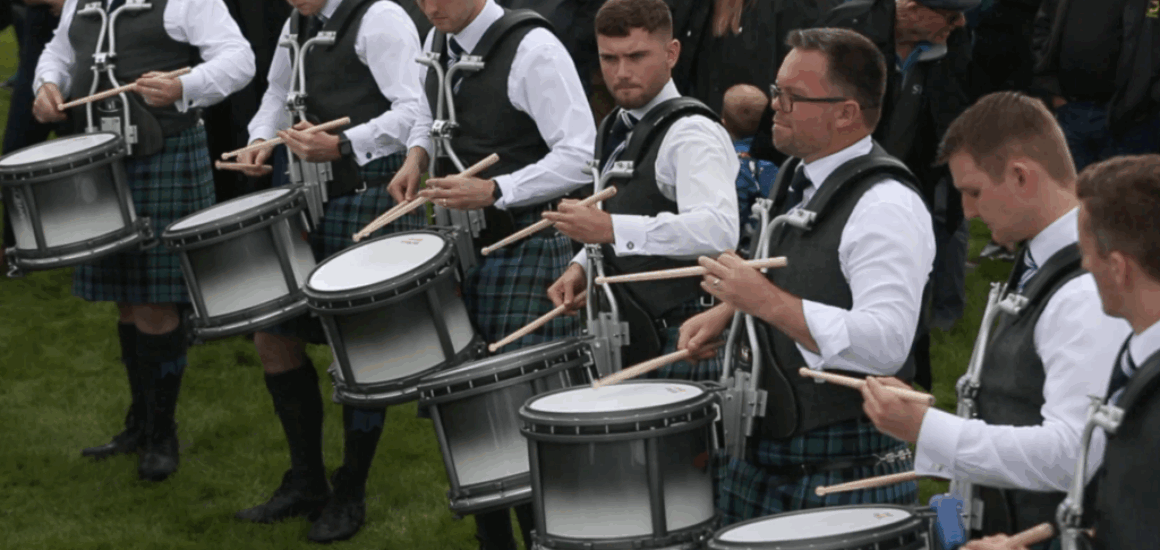
Pipe band drums, on the other hand, are pure precision instruments. The snares are tuned higher than your patience during band practice. The heads are synthetic and stretched to near-breaking point, giving that iconic crack that could wake the dead. The sticks are lighter, the rolls are tighter, and the sound is crisp — think machine gun, but musical.
And the tenor drums? Totally different game. In marching bands, tenors (a.k.a. “quads”) are melodic percussion beasts. In pipe bands, tenor drummers twirl their mallets, add rhythmic flair, and literally dance with their drums. It’s part music, part choreography, part drumline Cirque du Soleil.
Then there’s the bass drum. Marching band bass drummers carry massive, chest-thumping beasts that boom across football fields. Pipe band bass drummers play one drum — big, warm, and powerful — and it’s the heartbeat of the band. No multiple sizes here. Just one enormous pulse of Scottish thunder.
3. The Style: Showmanship vs. Subtlety
Marching band drummers perform for the crowd — stick tricks, visual choreography, synchronized head bobs. Their drumming is half music, half visual performance art. Every rimshot, stick toss, and sideways crab step is meant to dazzle.
Pipe band drummers? Their show is subtler — but no less impressive. The focus is on ensemble precision. Every tap, roll, and flam must blend perfectly with the pipes. You don’t just play your part — you weave into the music. It’s about texture, not theatrics. (Though if your tenor drummers are twirling their mallets in perfect unison, that’s a show all its own.)
In short: marching band drummers are rockstars on a field; pipe band drummers are watchmakers with sticks.
4. The Rudiments: From Rudimental to Ridiculous
If you think you’ve mastered drumming rudiments, try switching styles for a day. You’ll realize quickly that what feels natural in one world feels alien in the other.
Marching band drumming thrives on the American rudimental system — flam taps, paradiddles, ratamacues, and those insane hybrid licks that sound like someone typing fast on a mechanical keyboard. Speed, endurance, and flash rule the day.
Pipe band drumming, though? That’s a whole new language. Instead of standard flams, you’ve got “buzz rolls,” “five-stroke rolls,” “drags,” and “taorluaths” (which sound more like ancient Gaelic incantations than drum patterns). The technique is tighter, the stick grip is different (traditional grip reigns supreme), and the rolls are so controlled you could mistake them for white noise.
So while a marching drummer might be yelling “CHEESE DIDDLES LEFT LEFT RIGHT!” a pipe band drummer is calmly reciting, “flam drag-drag open double roll check.” They both make sense… if you squint hard enough.
5. The Uniforms: Polyester vs. Plaid
A marching band drummer’s uniform is sleek, sharp, and aerodynamic — designed to look good under stadium lights and withstand the occasional tuba collision. You’ve got shiny hats, feathers, and maybe some sequins if your school’s budget allows.
A pipe band drummer, meanwhile, looks like they stepped out of a Scottish time portal: kilt, sporran, hose, flashes, the whole nine yards. It’s part tradition, part fashion statement, and 100% guaranteed to confuse your laundry machine.
Marching band drummers march like athletes; pipe band drummers march like dignified Highland warriors — both with impeccable posture and questionable shoe comfort.
6. The Setting: Stadiums vs. Streets
Marching band drummers own the football field. They thrive in formation — block drills, halftime shows, epic field spreads that make fans gasp. It’s performance art with a metronome.
Pipe band drummers, on the other hand, rule the streets and the parade grounds. They play in rain, sun, mud, and occasionally next to livestock. Their playgrounds are Highland games, ceremonies, and competitions where the wind will absolutely mess with your sticks at least once.
And when the band starts marching down the road and the pipes echo off the buildings? It’s pure magic — the kind that makes you feel like you’re leading a medieval army into battle. (A very polite, musically disciplined army.)
7. The Attitude: Team Spirit vs. Clan Pride
Both types of drummers have strong camaraderie, but the vibes differ.
Marching bands are all about team energy — pep rallies, spirit chants, and post-show high-fives. You’re part of a massive machine built for spectacle and school pride.
Pipe bands? They’re more like families with drums — fiercely proud, humorously competitive, and bonded by shared suffering (and usually shared snacks). After the parade, you’ll find them at the beer tent debating whether the lead drummer or the weather was to blame for that missed roll-off.
8. The Reward: Cheers vs. Cheers (of a Different Kind)
At the end of a performance, marching band drummers get thunderous applause and maybe a trophy if the judges aren’t still arguing about intonation.
Pipe band drummers get something even better: the deep satisfaction of having survived another set of “Highland Cathedral” in full regalia — and a pint with their bandmates afterward. One type of cheer comes from the crowd; the other comes from your mates at the pub. Both feel pretty good.
Final Thoughts
So, which kind of drumming is better? Trick question — they’re both brilliant in their own ways.
Marching band drumming is the spectacle of precision and pageantry. It’s loud, proud, and visually stunning. Pipe band drumming is the art of subtle control and musical unity — centuries of tradition packed into every flam and drag.
If marching band drumming is a firework show, Highland pipe band drumming is a thunderstorm rolling over the moors: steady, powerful, and hauntingly beautiful.
So whether you’re a rudimental speed demon or a tartan-clad rhythm craftsman, keep drumming, keep learning, and most importantly — keep having fun. Because at the end of the day, we’re all just percussionists trying to make the world a little louder (and a lot more interesting).