


J. Nathaniel Lee
About J. Nathaniel Lee
Posts by :
Marching Band Drumming vs. Highland Pipe Band Drumming: Same Sticks, Totally Different Planet
Drummers are a special breed of humans — part athlete, part musician, and part caffeine-fueled metronome. They hit things with purpose and precision while making it look ridiculously cool. But if you think all drumming is the same, you’ve clearly never seen a Highland pipe band drummer and a marching band drummer standing side by side.
Sure, they both wear uniforms, carry drums, and occasionally twirl their sticks like wizards — but that’s where the similarities end. The difference between the two worlds is like comparing a Scottish sword dance to a halftime show at the Super Bowl: both epic, both loud, but very, very different.
So grab your sticks, tighten your sling, and let’s dive into the wonderful chaos that separates (and secretly unites) these two drumming tribes.
1. The Music: Brass vs. Bagpipes
Let’s start with the obvious. Marching band drummers are surrounded by brass, woodwinds, and a conductor who looks like they just chugged three espressos. The music is big, bold, and dynamic — think movie soundtracks, pop tunes, and “Sweet Caroline” at football games.
Pipe band drummers? They’re in a very different sonic universe. Their melodic partners are bagpipes, and bagpipes… well, they play in one key. Constantly. Forever. Usually around A(ish) — depending on the humidity, temperature, and how mischievous the reeds feel that day.
That means pipe band drummers don’t have flashy tempo changes or dramatic crescendos. Instead, they build rhythm and texture within that one endless drone. They don’t just back the pipers — they dance with them rhythmically. It’s less about boom-crash and more about click-tap-sizzle-finesse.
So while a marching band drummer might be pounding out the finale to Bohemian Rhapsody, a pipe band drummer is crafting a delicate, rolling tattoo to make the pipes sing. Both are awesome. One might get you a high school trophy; the other might get you a pint after the parade.
2. The Instruments: The Hardware Wars
At first glance, both styles use snare drums, tenors, and bass drums. But once you look closer, you realize you’ve wandered into two completely different dimensions.
Marching band drums are often sleek, modern, and (let’s be honest) built like small tanks. They’re made for projection — the snares are tight enough to bounce a quarter, and the tenors look like a futuristic space cannon array. You’ve got quads, quints, even sextets — all mounted on harnesses that could double as medieval armor.
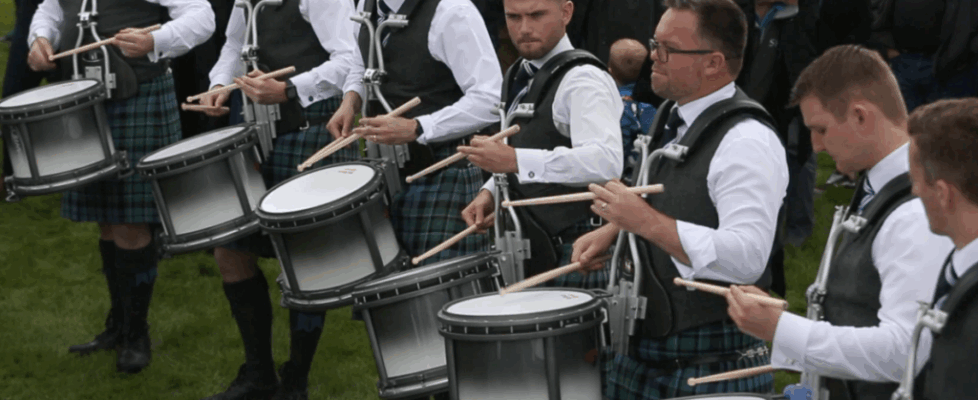
Pipe band drums, on the other hand, are pure precision instruments. The snares are tuned higher than your patience during band practice. The heads are synthetic and stretched to near-breaking point, giving that iconic crack that could wake the dead. The sticks are lighter, the rolls are tighter, and the sound is crisp — think machine gun, but musical.
And the tenor drums? Totally different game. In marching bands, tenors (a.k.a. “quads”) are melodic percussion beasts. In pipe bands, tenor drummers twirl their mallets, add rhythmic flair, and literally dance with their drums. It’s part music, part choreography, part drumline Cirque du Soleil.
Then there’s the bass drum. Marching band bass drummers carry massive, chest-thumping beasts that boom across football fields. Pipe band bass drummers play one drum — big, warm, and powerful — and it’s the heartbeat of the band. No multiple sizes here. Just one enormous pulse of Scottish thunder.
3. The Style: Showmanship vs. Subtlety
Marching band drummers perform for the crowd — stick tricks, visual choreography, synchronized head bobs. Their drumming is half music, half visual performance art. Every rimshot, stick toss, and sideways crab step is meant to dazzle.
Pipe band drummers? Their show is subtler — but no less impressive. The focus is on ensemble precision. Every tap, roll, and flam must blend perfectly with the pipes. You don’t just play your part — you weave into the music. It’s about texture, not theatrics. (Though if your tenor drummers are twirling their mallets in perfect unison, that’s a show all its own.)
In short: marching band drummers are rockstars on a field; pipe band drummers are watchmakers with sticks.
4. The Rudiments: From Rudimental to Ridiculous
If you think you’ve mastered drumming rudiments, try switching styles for a day. You’ll realize quickly that what feels natural in one world feels alien in the other.
Marching band drumming thrives on the American rudimental system — flam taps, paradiddles, ratamacues, and those insane hybrid licks that sound like someone typing fast on a mechanical keyboard. Speed, endurance, and flash rule the day.
Pipe band drumming, though? That’s a whole new language. Instead of standard flams, you’ve got “buzz rolls,” “five-stroke rolls,” “drags,” and “taorluaths” (which sound more like ancient Gaelic incantations than drum patterns). The technique is tighter, the stick grip is different (traditional grip reigns supreme), and the rolls are so controlled you could mistake them for white noise.
So while a marching drummer might be yelling “CHEESE DIDDLES LEFT LEFT RIGHT!” a pipe band drummer is calmly reciting, “flam drag-drag open double roll check.” They both make sense… if you squint hard enough.
5. The Uniforms: Polyester vs. Plaid
A marching band drummer’s uniform is sleek, sharp, and aerodynamic — designed to look good under stadium lights and withstand the occasional tuba collision. You’ve got shiny hats, feathers, and maybe some sequins if your school’s budget allows.
A pipe band drummer, meanwhile, looks like they stepped out of a Scottish time portal: kilt, sporran, hose, flashes, the whole nine yards. It’s part tradition, part fashion statement, and 100% guaranteed to confuse your laundry machine.
Marching band drummers march like athletes; pipe band drummers march like dignified Highland warriors — both with impeccable posture and questionable shoe comfort.
6. The Setting: Stadiums vs. Streets
Marching band drummers own the football field. They thrive in formation — block drills, halftime shows, epic field spreads that make fans gasp. It’s performance art with a metronome.
Pipe band drummers, on the other hand, rule the streets and the parade grounds. They play in rain, sun, mud, and occasionally next to livestock. Their playgrounds are Highland games, ceremonies, and competitions where the wind will absolutely mess with your sticks at least once.
And when the band starts marching down the road and the pipes echo off the buildings? It’s pure magic — the kind that makes you feel like you’re leading a medieval army into battle. (A very polite, musically disciplined army.)
7. The Attitude: Team Spirit vs. Clan Pride
Both types of drummers have strong camaraderie, but the vibes differ.
Marching bands are all about team energy — pep rallies, spirit chants, and post-show high-fives. You’re part of a massive machine built for spectacle and school pride.
Pipe bands? They’re more like families with drums — fiercely proud, humorously competitive, and bonded by shared suffering (and usually shared snacks). After the parade, you’ll find them at the beer tent debating whether the lead drummer or the weather was to blame for that missed roll-off.
8. The Reward: Cheers vs. Cheers (of a Different Kind)
At the end of a performance, marching band drummers get thunderous applause and maybe a trophy if the judges aren’t still arguing about intonation.
Pipe band drummers get something even better: the deep satisfaction of having survived another set of “Highland Cathedral” in full regalia — and a pint with their bandmates afterward. One type of cheer comes from the crowd; the other comes from your mates at the pub. Both feel pretty good.
Final Thoughts
So, which kind of drumming is better? Trick question — they’re both brilliant in their own ways.
Marching band drumming is the spectacle of precision and pageantry. It’s loud, proud, and visually stunning. Pipe band drumming is the art of subtle control and musical unity — centuries of tradition packed into every flam and drag.
If marching band drumming is a firework show, Highland pipe band drumming is a thunderstorm rolling over the moors: steady, powerful, and hauntingly beautiful.
So whether you’re a rudimental speed demon or a tartan-clad rhythm craftsman, keep drumming, keep learning, and most importantly — keep having fun. Because at the end of the day, we’re all just percussionists trying to make the world a little louder (and a lot more interesting).

How to Tune Your Bagpipes (Without Losing Your Mind or Scaring the Neighbors)
Ah, the sweet sound of the Great Highland Bagpipe — that majestic, spine-tingling, slightly alarming instrument that can make grown men weep, dogs howl, and tourists whip out their phones. But let’s be honest: a poorly tuned set of pipes sounds less like Scotland the Brave and more like a flock of angry geese fighting a leaf blower.
Tuning your bagpipes is both an art and a test of your sanity. Don’t worry — we’ve all been there: one drone flat, one drone sharp, and your chanter insisting on playing in some mysterious key only known to the Loch Ness Monster. But fear not, brave piper! By the end of this guide, you’ll know how to get your pipes in tune — or at least in the general vicinity of it.
Step 1: Understand What “In Tune” Actually Means
Let’s start with the basics: bagpipes aren’t like pianos or guitars. They don’t have handy tuning knobs or little digital screens that tell you when you’re perfect (wouldn’t that be nice?). Bagpipes are living, breathing beasts — sensitive to temperature, humidity, altitude, and your emotional state.
Your goal is to make all the parts — the drones and the chanter — play harmoniously together. The drones should produce a single, steady note, and your chanter should sing sweetly above it. When it all lines up just right, you’ll feel it. The sound locks in, angels sing, and you might even stop sweating for a moment.
Step 2: Warm Up (Because Cold Pipes Lie)
Just like you shouldn’t run a marathon straight out of bed (unless you enjoy injuries and regret), you shouldn’t tune cold bagpipes. Give your pipes a few minutes of warm-up playing before you start adjusting.
As the bag, reeds, and drones warm up, their pitch changes — usually upward. So if you tune cold, you’ll end up sharp later, and your bandmates will glare at you like you just insulted their tartan.
So blow steady, march in place, and let your pipes find their happy temperature. Think of it as foreplay for tuning.
Step 3: Time for the Chanter
Now comes the fun part — the chanter. This is where your melody lives, and it’s also the part most likely to make you question your life choices.
First, make sure your chanter reed is seated properly and not too open (which makes it sharp) or too closed (which makes it flat).
Play a low A and check how it sounds against your drones. That’s your foundation note. Everything else on the chanter will be tuned in relation to that.
Then, move up the scale — B, C, D, and so on — and listen. Are some notes sharp or flat? Adjusting the reed seating, taping the holes, or even changing reeds may be necessary. Yes, it’s fussy. Yes, you’ll want to throw your chanter across the room at least once. That’s normal.
Remember: bagpipes are reed instruments. Reeds are unpredictable. They’re like toddlers — you can’t reason with them, but you can learn what makes them behave.
Step 4: Tune the Bass Drone First
Your bass drone is the backbone of your sound — the steady hum of the universe (or at least your living room). Start by getting this guy stable and happy.
- Blow a steady note and listen.
- Adjust the tuning slide up or down until you hit that sweet spot where the tone stops wobbling and locks in.
Pro tip: if you find yourself twisting it endlessly, take a deep breath. The bass drone is moody, but with patience (and maybe a prayer to Saint Andrew), you’ll get it right.
If you have a tuner, great — but don’t rely on it entirely. Your ears are your best tool. (And your worst enemy, when your pipes are way off.)
Step 5: Add the Tenor Drones One at a Time
Once the bass is in tune, bring in one tenor drone and match it to the bass. This is where you’ll develop that thousand-yard stare all pipers get when they’re listening intensely for tiny pitch differences.
Move the slide just a smidge until the two drones blend into one beautiful, steady sound — no waves, no beating. If it sounds like two mosquitoes arguing, you’re not there yet.
Now, add the second tenor and match it to the first. When all three drones are perfectly in sync, the sound will be glorious — rich, full, and capable of making a grown Scotsman cry into his haggis.
Step 6: Learn to Tape Like a Pro
No, we’re not talking about fixing your car’s bumper. Bagpipe tape is the secret weapon of every good piper.
If a note is too sharp, place a bit of tape over the top edge of the hole to flatten it. If it’s too flat, remove some tape or open the hole slightly.
Use electrical tape (black is traditional because it looks cool and mysterious) and make small adjustments. Think of it as surgery, not demolition.
Pro tip: if your chanter starts looking like it lost a fight with a roll of duct tape, you might want to start over. Less is more.
Step 7: Keep Everything Steady
Tuning is only half the battle. The real magic happens when you can hold your pressure steady while playing. If your blowing pressure is all over the place, so will your tuning be.
Practice blowing at a consistent strength — not too hard, not too soft, just steady. It’s like yoga for your diaphragm. (Except louder. Much louder.)
Step 8: Maintenance Matters
Once you’ve tuned your pipes, don’t neglect them. Moisture control, hemping, and reed care all affect tuning stability.
Keep your bag dry (but not too dry), check for air leaks, and make sure your reeds aren’t older than your favorite pair of socks. Even the best-tuned pipes will sound tragic if the reeds are worn out.
A little care goes a long way — and your future self (and your bandmates) will thank you.
Step 9: Know When to Stop
Here’s a secret: no set of bagpipes is perfectly in tune. Ever. The goal is to get them as close as possible before you lose your patience (or your band’s goodwill).
When your pipes sound good and the drones are steady, stop fiddling. Seriously. Step away slowly. Go reward yourself with a pint or a scone. You’ve earned it.
Step 10: Laugh at the Chaos
Bagpipes are not for the faint of heart. They will squeal, groan, and test your sense of humor daily. But that’s part of the joy.
Every piper you’ve ever heard — even the pros — has had those days when nothing sounds right. They’ve all muttered words not fit for print and questioned their life choices. The secret is to keep laughing and keep playing.
Because when your pipes are in tune and everything locks together just right — there’s no sound on Earth like it. It’s powerful. It’s proud. It’s slightly terrifying. And it’s yours.
Final Thoughts
Tuning your bagpipes isn’t about achieving robotic perfection — it’s about learning to dance with a slightly unpredictable partner. You’ll get better each time you do it. Your ears will sharpen, your patience will grow, and eventually, you’ll be that wise piper helping the next poor soul find their tuning zen.
So go on, pick up those pipes, give them a warm-up, and start tuning. Remember: if it sounds bad, it’s not the pipes — it’s definitely the humidity.
Frank W (Bill) Lee
Frank Lee III Published Obituary
Frank William “Bill” Lee III, 75, of Moline passed away on Sunday, July 17, 2022 at home.
A funeral service will be held at 1:00 pm on Saturday, July 23, 2022 at Christ Anglican Church, 1717 8th Ave Moline. Private inurnment will be at a later date in Nashotah House Cemetery, Waukesha, WI. Memorials may be made in care of Nashotah House Theological Seminary or Monmouth College.
Bill was born on December 3, 1946 in Detroit, Michigan, the son of Frank William Lee Jr. and Mary Isabelle Kuhlman. He graduated from Monmouth College in 1969 with a Bachelor’s degree in History. Bill married Margaret “Peggy” Will Lee on November 3, 1972 in St. Louis, Missouri. He worked as a Procurement Analyst for TACOM on the Rock Island Arsenal for 30 years.
Bill’s passions included reenacting with the North West Territory Alliance, where he was a part of the 84th Highland Regiment and then the British Marines. He was a part of various pipe bands over the years, including Monmouth College Highlanders, Kansas City- St. Andrews Society, St. Louis- Meeting with the Waters, Morten Highlanders, Peoria- Celtic Cross, and most recently, Blackhawk Pipes and Drums.
Bill loved his wife Peggy, his family and friends, the pipe band, the NWTA, and a good joke (some bad ones, too). He loved to tell stories, get into shenanigans, and a good drink. If you were fortunate enough to meet him, you would know he loved always and smiled often.
Those left to cherish his memory include his wife, Peggy; children, Jasmine (Joshua Rotkin) Lee and Joshua (Crystal) Lee, both of Moline; and grandchildren, Kayla and Edward Sierra-Lee, Devlin, Alannagh, and Bergan Lee.

Roger Stancliff
Roger Stancliff Obituary
Glen “Roger” Stancliff of Andover, IL passed away on Wednesday, August 26th at the University of Iowa Hospital, as a result of complications from the COVID-19 virus. A memorial service will be held at 10:00 a.m. on Saturday, September 5th at Lake Park in Andover, IL. Due to limited seating and social distancing requirements, attendees are asked to bring lawn chairs if needed. Cremation rites will be accorded. Inurnment will immediately follow at Aledo Cemetery, Aledo, IL. A private family visitation will be held at Vandemore Funeral Homes & Crematory – Geneseo Chapel. Memorials may be directed to First Presbyterian Church-Geneseo, Osco/Andover Fire Department, or the University of Iowa Stead Family Children’s Hospital.
Roger was born on October 21, 1940, in Aledo, IL, the son of Glen E. and Grace E. Decker Stancliff. After graduating from Aledo High School and Bradley University (where he was a member of Lambda Chi Alpha fraternity) with a bachelor’s degree in Speech and English, he spent time teaching in the Aledo schools and at the former Roosevelt Military Academy. During the 1960s, Roger trained in San Diego as a member of the Navy Reserves. He later worked as President and CEO in several area banks, including The State Bank of Osco, Buffalo Prairie State Bank, and after retirement, as a consultant for Reynolds State Bank.
Roger was a member of the Mississippi Valley Firefighter’s Association, the Governor’s State Fire Advisory Committee, and the Osco/Andover Fire Department, where he served as Chief for over 30 years.
Roger married Karen Caylor in Bushnell, IL on June 27, 1970. He and his wife loved to travel, especially to his beloved Scotland. He also loved to play cards with his dear friends and family. Late in life, Roger joined the Blackhawk Pipes and Drums, where he learned to play the bagpipes. He often shared his ability playing in parades and for special occasions.
Roger was a very kind and giving person. His faith was strong, and he was an active member of Geneseo First Presbyterian Church, where he served as an Elder and member of Mission and Outreach, frequently helping to coordinate meal sites for the needy. He always looked forward to supporting the Geneseo Green Machine and his Iowa Hawkeye Wrestlers, and rarely missed a game or match for either. Most of all, he cherished time with his family, gathering for holidays and special occasions, loving on his grandchildren, and retelling stories from the past. We will truly miss this loving and giving person that touched so many lives in so many different ways.
Surviving Roger are his wife of 50 years, Karen; son, Michael of Erie, CO; daughter, Mary (Barrett) Essman of Rock Island, IL; grandchildren, Gabrielle Stancliff, Eva and Joey Essman; brother, C.W. (Red) Stancliff of Aledo, IL; many loved nieces, a nephew, and his cousins. Roger was preceded in death by his parents, Grace and Glen.